Blog
INDIAN COTTON AT A GLANCE

The Story of Indian Cotton: History, Agriculture, and Diversity
The story of Indian cotton is, in many ways, the story of global commerce itself. Long before synthetic fibers redefined fashion or industrial automation accelerated global trade, a humble, soft-bolled plant cultivated along the banks of the Indus River laid the foundation for one of the world’s oldest and most influential industries.
Today, cotton remains deeply woven into India’s economic, cultural, and social fabric.
1. Deep Roots: From Mohenjo-Daro to the World Stage
India’s relationship with cotton stretches back over 5,000 years. Archaeological findings at sites like Mehrgarh, Harappa, and Rakhigarhi reveal that weavers of the Indus Valley Civilization were already spinning, dyeing, and wearing cotton textiles around 3000 BCE. Ancient texts refer to it as Karpasa, and Roman historians later marveled at Indian fabrics so fine they were described as “woven air” or “subtle as a cloud.”
The Muslin Legacy: For centuries, Dhaka muslin—crafted from indigenous Indian cotton—was considered the pinnacle of luxury, prized across the Roman Empire, Persia, and imperial China for its sheer light weight and unmatched softness.
During the British colonial era, the trajectory of Indian cotton shifted dramatically. Raw cotton was exported in vast quantities to power the mechanized textile mills of Manchester, while finished British cloth was sold back to Indian markets. This dynamic eventually inspired Mahatma Gandhi to adopt the Charkha (spinning wheel) as a visual symbol of self-reliance, national independence, and sustainable local craft during the Swadeshi movement.
2. A Global Agricultural Powerhouse
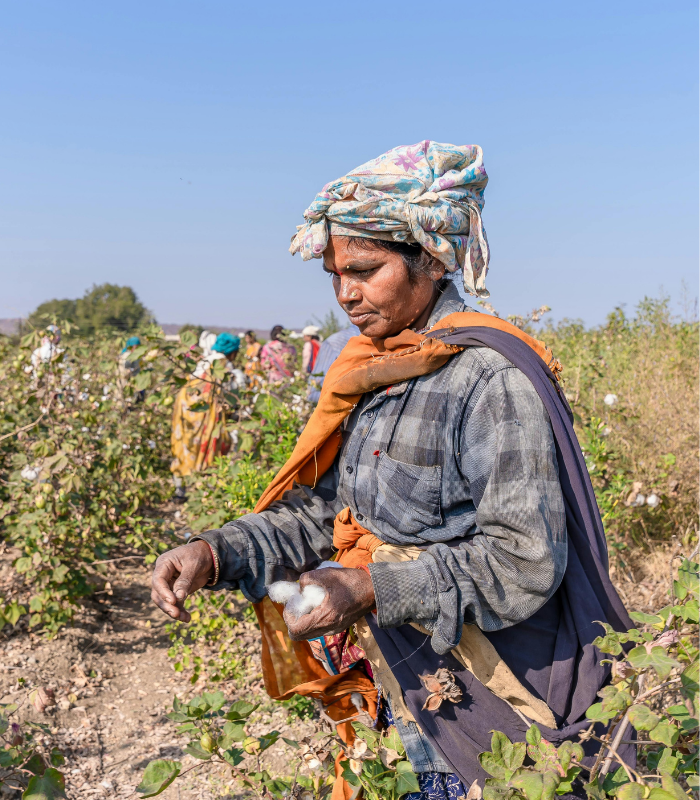
Fast forward to the present: India stands as the world’s largest producer of raw cotton (accounting for roughly 23% of global output) and holds the largest land area dedicated to cotton cultivation.
(Data sources: Cotton Association of India / Ministry of Textiles)
The Three Growing Belts
Cotton cultivation in India is split into three main geographical zones, each with unique climate conditions and soil profiles:
- Northern Zone (Punjab, Haryana, Rajasthan): Characterized by rich, irrigated alluvial soils and early sowing cycles.
- Central Zone (Maharashtra, Gujarat, Madhya Pradesh): The heartland of production, relying heavily on fertile black cotton soils (Regur) and seasonal monsoon rains.
- Southern Zone (Telangana, Andhra Pradesh, Karnataka, Tamil Nadu): Known for varied soil types and multi-season cultivation.
3. Diversity of Species & Fabrics
India is unique in its agricultural diversity: it is the only nation in the world that commercially cultivates all four species of cotton:
- Gossypium hirsutum (American/Upland cotton — makes up the vast majority)
- Gossypium arboreum (Desi/Asiatic cotton)
- Gossypium herbaceum (Asiatic cotton native to dry regions)
- Gossypium barbadense (Extra-long staple cotton)
Key Traditional & Modern Indian Cotton Fabrics
- Khadi
- Character: Hand-spun, hand-woven, highly breathable, and textured.
- Common Uses: Heritage wear, shirts, sarees, and sustainable fashion.
- Muslin
- Character: Ultra-lightweight, fine plain weave, extraordinarily soft.
- Common Uses: Dresses, scarves, and baby wraps.
- Poplin
- Character: Smooth, crisp, durable plain weave with fine ribs.
- Common Uses: Formal shirts, everyday garments, and uniform wear.
- Chanderi & Maheshwari
- Character: Fine cotton blended with silk, often featuring delicate gold zari borders.
- Common Uses: Festive sarees, dupattas, and luxury ethnic wear.
4. Modern Challenges & The Road Ahead
Despite its dominant position, the Indian cotton ecosystem faces pressing structural challenges:
- Climate Reliance: Over 60% of cotton acreage remains rain-fed, making crop yields highly sensitive to unpredictable monsoon patterns and shifting weather conditions.
- Pest Vulnerability & Water Usage: Managing bollworm infestations and high irrigation demands requires ongoing innovation in sustainable farming practices.
- Shift Toward Organic: To counter environmental degradation, India has emerged as a major hub for Organic Cotton production, driven by rising global demand for eco-certified textiles free of chemical pesticides.
Driven by government initiatives to modernize processing technology, strengthen farmer minimum support prices (MSP), and expand sustainable supply chains, India’s “White Gold” remains a vital pillar of the nation’s economic landscape.